

Precise 3D CT Scan Islamabad for Clear Medical Insights
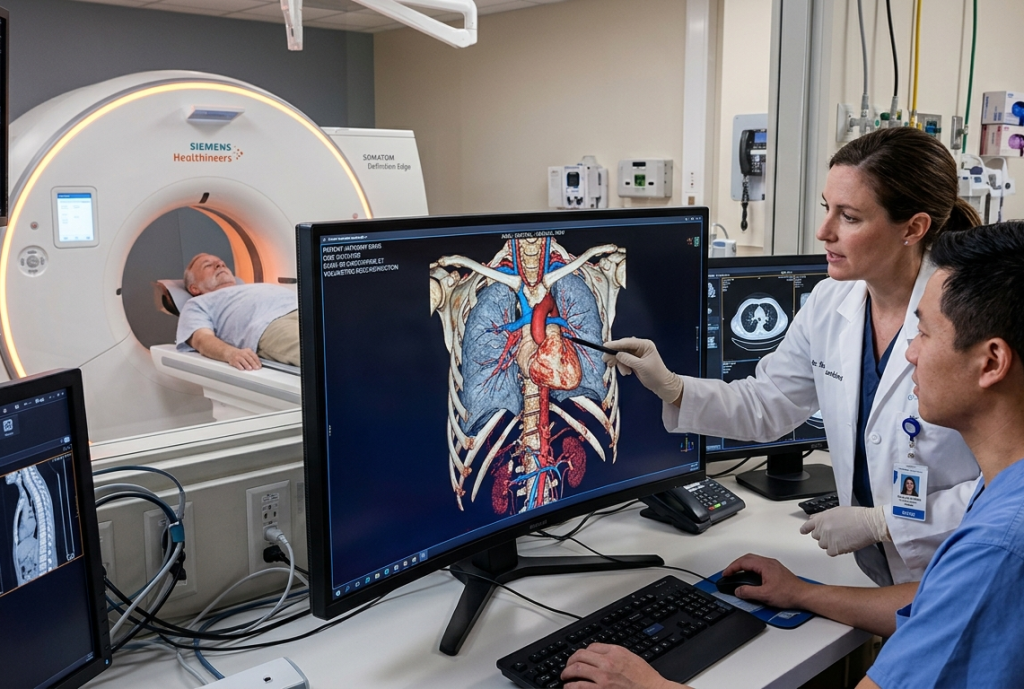
Some clinical questions cannot be answered by looking at flat cross-sectional slices alone. An orthopaedic surgeon planning a complex joint reconstruction a maxillofacial specialist assessing a facial fracture before surgery or a neurosurgeon who needs a spatial map of the skull base all of them need something beyond a standard two-dimensional image.
ODC provides 3d ct imaging across a wide range of clinical applications covering the musculoskeletal system facial and cranial anatomy and thoracic structures. Every scan is acquired on high-specification equipment with the reconstruction performed and reported by a qualified radiologist who understands how to translate three-dimensional anatomy into clinically useful findings.
Reliable Centre for 3D CT Scanning in Islamabad
Three-dimensional CT reconstruction is not simply a visual upgrade over standard CT. It is a distinct analytical tool that changes how complex anatomical relationships are understood and communicated between radiologists and the surgeons or specialists who rely on imaging to plan procedures. A 3d ct scan produced on equipment that lacks the resolution or processing capability for quality volumetric reconstruction produces images that look three-dimensional but carry limited diagnostic value for the clinical decisions that depend on them. ODC has developed its standing in Islamabad by holding to a standard where reconstruction quality and radiologist expertise are treated as inseparable from the scanning process itself.
Every referral for a 3d ct scan goes through the same clear and consistent process from booking to report delivery. The 3d ct scan price is confirmed before any appointment is finalised with no additions introduced after the scan is completed. Whether the referral covers a single joint a facial region or a full cranial study the fee is stated upfront and the report is prepared by a qualified radiologist without unnecessary delay. Surgeons and specialists who need three-dimensional imaging to plan a procedure cannot work from a report that arrives after the clinical window has closed. Timely and technically complete delivery is part of what ODC considers a basic clinical obligation.
3D Technology
Every 3d CT scan uses maintained high specification CT equipment enabling accurate volumetric reconstruction and clinical reporting.
Full Joint Coverage
3D CT imaging is available for musculoskeletal cranial facial thoracic and dental applications covering all major referral types.
Radiologist Reporting
Every 3D study is reported by an experienced radiologist whose structured findings are written for direct specialist use in care.
Confirmed Scan Cost
3D CT scan cost is confirmed before booking. Full fee is stated regardless of region with no extra charges after the study is done.
Flexible Scheduling
Morning and evening appointment slots are available Monday to Saturday so both routine referrals and clinically urgent bookings are placed.
Managed CT Imaging
Every scan is done in a supervised imaging environment by trained staff following strict radiation safety protocols without exception.
Your 3D CT Scan From Arrival to Complete Report
Attending a 3D CT scan appointment is a straightforward process that most patients find considerably simpler than they anticipated. 3D CT scan preparation depends on the body region being examined and the specific protocol your doctor has ordered. For most musculoskeletal studies including the knee shoulder elbow and facial bones no fasting is required and patients can attend without changing their normal daily routine. For studies of the abdomen or pelvis that incorporate three-dimensional reconstruction the standard pre-scan preparation guidance for those body regions applies. On the day you will be asked to remove any metallic items near the scan region and lie still on the CT table.
The acquisition itself takes a few minutes and the three-dimensional data is generated from the same raw CT images captured during the standard scan. The 3d reconstruction ct scan process happens after image acquisition is complete. The radiographer transfers the raw CT data to a workstation where dedicated software reconstructs the volumetric model of the target anatomy. The reporting radiologist then reviews both the standard cross-sectional images and the three-dimensional reconstruction together to write a complete and clinically useful report. This dual review approach means the report captures both the fine slice-level detail and the spatial anatomical relationships that the three-dimensional model uniquely reveals.
What a 3D CT Scan Shows Clinicians
The answer is that it uses the same CT acquisition as a conventional scan but adds a volumetric reconstruction step that transforms the cross-sectional slices into a navigable three-dimensional model. What can a 3d ct scan show in clinical terms goes beyond what flat two-dimensional images communicate. Complex fracture patterns and their spatial relationships are clearly visualised allowing surgeons to understand exactly how fragments are displaced before they operate. Joint congruency in conditions like severe arthritis or developmental dysplasia is assessed in three dimensions rather than inferred from two-dimensional slices.
3D CT Scan vs Standard CT Scan
Understanding the difference between 3d ct scan and normal ct scan helps patients appreciate why their surgeon or specialist has specifically requested the three-dimensional version of the study rather than a standard acquisition. A conventional CT scan produces a series of cross-sectional slices that the radiologist reads sequentially to build a mental picture of the anatomy. The images are two-dimensional and the relationship between structures across the three-dimensional space of the body is inferred rather than directly visible. 3d ct scan vs ct scan in practical clinical terms means the difference between inferring spatial anatomy from individual slices and seeing.
3D CT Scan vs MRI
Patients who have been offered a choice or who receive conflicting advice about which imaging study is appropriate often ask about 3d ct scan vs mri and the clinical answer is clear once the diagnostic question is properly defined. Three-dimensional CT is the superior modality for bone and cortical structure imaging.MRI has the advantage for soft tissue assessment cartilage ligaments tendons and marrow pathology are all better evaluated on MRI than on CT. Our laboratory services and radiology department operate in close coordination with the biopsy unit so the full diagnostic picture around your case is as complete as possible from day one.
Clear Pricing and Booking
Knowing the full cost of an investigation before attending removes one layer of uncertainty from an already difficult process. Patients searching for a reliable 3d scan will find the booking process clear and the pricing structure consistent from first contact to final report delivery. ODC’s laboratory and radiology services are built on the same principle of transparent and honest patient-first pricing. No additional charges are applied after the scan is completed. Appointments are available Monday to Saturday from 11:00 AM to 8:00 PM and are confirmed at the time of scheduling. Full booking and contact information is available on the contact page.
Give Your Surgeon the Imaging That Changes the Plan
Our Location
Appointment
What Our Patients Say About ODC
Earning trust as a three-dimensional imaging centre in Islamabad requires more than advanced equipment it requires consistent delivery of studies that genuinely serve the clinical decisions that depend on them. Surgeons who referred patients for a 3d ct scan through ODC received reconstructions that were complete precise and accompanied by a radiologist report they could work from directly. Patients who attended left without the confusion of unclear pricing or unexpected delays. The scan was done. The reconstruction was complete. The report reached the surgeon when pre-operative planning required it. Whether the referral was for a joint a facial region or a cranial study every appointment received the same level of technical care and clinical follow-through.
Trustindex verifies that the original source of the review is Google. I visit odc very nice staff and helpful to the patient in any activity in the odcPosted onTrustindex verifies that the original source of the review is Google. very well staff good environment recommendedPosted onTrustindex verifies that the original source of the review is Google. Good servicesPosted onTrustindex verifies that the original source of the review is Google. One of the best diagnostic in Islamabad highly professional doctor and advance lab good staff and clean environmentPosted onTrustindex verifies that the original source of the review is Google. Good and neat environment good facilitiesPosted onTrustindex verifies that the original source of the review is Google. Friendly helping staff I'm so satisfied with service given to us.They are the best.Posted onTrustindex verifies that the original source of the review is Google. Good servicesPosted onTrustindex verifies that the original source of the review is Google. Good centerPosted onTrustindex verifies that the original source of the review is Google. Best staff and lab very happyPosted onTrustindex verifies that the original source of the review is Google. Nice and efficient staff
Frequently Asked Questions
What is a 3D CT scan and how is it different from a normal CT
A 3d ct scan uses the same raw CT acquisition as a standard scan but adds a volumetric reconstruction step that produces a three-dimensional model of the target anatomy.
What can a 3D CT scan show?
3d ct scan show in clinical practice includes complex fracture patterns and fragment displacement joint congruency and dysplasia facial and cranial bone anatomy before surgery vascular anatomy in three dimensions and any bony structure.
How much does a 3D CT scan cost in Islamabad?
The 3d ct scan price at ODC depends on the body region and protocol involved. Fees for knee shoulder facial and other region-specific studies are each confirmed clearly before any appointment is finalised.
Can a CT scan be 3D?
Yes. Can ct scans be 3d is a question many patients raise and the answer is yes. Standard CT acquires data as a series of cross-sectional slices. Three-dimensional reconstruction software uses those slices to build a volumetric model of the scanned anatomy.
Is a 3D CT scan safe?
3D CT scanning uses the same radiation as a standard CT of the same body region because the 3D reconstruction is produced from the same raw image data rather than requiring additional scanning. Radiation safety protocols are followed on every study.